

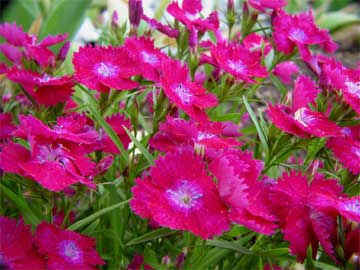
Not many gardeners know that the pinks (Dianthus, pronounced dye-AN-thus) are among the oldest of the cultivated flowering plants.
Reference is made to the clove carnation by Pliny in the first century A.D.
Wild forms of Dianthus plants occur in central and northern Europe, Asia, South Africa, China and Alaska.
It was one of the earliest plants cultivated by man primarily for ornamental purposes. It also was used, however, to flavor wines in France and Spain.
The Dianthus pinks were the first flowers cultivated in greenhouses and the first to be developed by controlled hybridization. Dianthus also is said to be the first plant on which an entire book was written.
The cultivation and care of dianthus plants and carnations reached an advanced stage in England where they were known as clove and carnation gilliflowers, a romantic term also applied to other flowers such as stocks, sweet rocket, wallflowers and others.
Clove gilliflowers were the most popular flowers of the olden days.
An old fashioned favorite comprising many horticultural varieties, the dianthus is dainty, dashing and delightfully fragrant.
It also is very floriferous and colorful. There are varieties for the rock garden, wall garden and the flower border.
Plant size varies from low to tall and there are annuals, biennials, and perennials among them.
Few other ornamental flowering plants are so varied and versatile. No wonder their popularity has persisted uninterrupted for many centuries, in many countries.
The Sweet Williams Dianthus
Perhaps the best known of the Dianthus clan is sweet William (Dianthus barbatus) which bears its brilliantly colored blooms in large clusters at the top of stout stems.

It is a biennial easily grown from seeds, producing a strong clump the first season and flowers the following year, blossoming all summer.
There are both single and double forms of sweet Williams and seeds can be obtained that will produce pure white, red, and salmon pink flowers as well as the multicolored forms, in plant heights ranging from three or four inches to 1-1/2 to 2 feet tall.
Various seed companies feature their own varieties, with very low growing kinds in both singles and doubles that are especially suited to rock gardens and the edges of narrow perennial borders. The tall varieties belong in the middle ground of the flower border.
Care of the Dianthus plant sweet Williams is very simple; they are affected by few pests, grow vigorously in an average soil and are not too demanding so far as water is concerned.
Prevention of seed formation by removal of spent blooms will prolong the flowering season. Plantings are perpetuated year after year if but a few seeds are allowed to develop from which volunteer seedlings are produced.
Volunteer seedlings that bloom the following year lead many uninformed gardeners to think that sweet William is perennial.
These Are Annuals
Looking very much like sweet William plant, the China pinks (Dianthus chinensis) sometimes referred to as the rainbow pinks or annual pinks, are of extremely easy culture.
They grow rapidly from seeds sown early in the season in the garden or started ahead of the season in a cold frame or sunny window.
Both single and double flowering forms and many horticultural varieties are available.
This is one of the few pinks that do not possess fragrance, but it more than makes up for this lack by its happy, colorful blooms that make a brilliant garden display throughout the summer and into fall if spent blooms are removed before they set seeds.
They are excellent cut flowers for low containers. Many named varieties of specific colors and flower forms are listed in seed catalogs.
China pinks can be grown with perennials, alongside early summer flowering varieties, to give a continuation of color.
They make very good temporary replacements for perennials that fail to survive the winter and they can be used advantageously over spring flowering bulbs that leave a bare space when they go dormant.

The clove or cottage pinks (Dianthus plumarius) are very old garden favorites. They are among the most fragrant flowers, having a decidedly spicy odor that never fails to be noticed.
They are very hardy, low-growing, spring flowering perennials that should be planted in patches along garden paths, in rock garden or on the edge of the perennial border.
Colors vary in shades of light lilac, rose, pink and red. Some have darker centers.
Named varieties are too numerous to mention page through seed catalogs as your consultant for colors and plant size to suit personal taste. They are easily grown from seeds and plants start blooming the second year.
The Daintiest Pinks
Perhaps the daintiest of the Dianthus flower is the maiden pink (Dianthus deltoides), a very low growing species.
Flowers are very small and produced in great profusion throughout the summer months. They are especially adapted to walls and rock gardens or any place where a low, tufted, hardy perennial is desired.
Flowers are mostly pink or rose, scarlet or white and have little fragrance. Like all the Dianthus they are easily grown from seeds in average garden soil. Plants start flowering the second year.
The Grenadins constitute a group of garden carnations that are not reliably hardy in the North but may be dependable in the central and southern sections of the Midwest.
They resemble the florist carnation in every way except size, being much smaller. They flower throughout the summer and will bloom the first year from seed if started early under glass.
All the varieties of dianthus are easily grown and have very few enemies.
The new all purpose insecticide-fungicide applied as a spray used two or three times during the season will keep them safe from insects and diseases.
All varieties prefer full sun and enough room to expand without being crowded by other plants.
Few plants compare with them as far as ease of culture is concerned, yet they are commonly overlooked. It is time for a revival of interest in this ancient and once popular flower.

{ 1 comment… read it below or add one }
The Dianthus has to be one of my favorite flowering plants. The reason is due to the number of varieties that each has to offer individually from the various flowering colors and shades to the interesting colors and textures of the foliage.
To start, the Dianthus deltoides ‘Arctic Fire’ (common name ‘Pinks-Maiden’) provides a clean fresh early summer look with it’s serrated white 5 petals and pink centers with a dark ring that separates the two colors. It will bloom again in the fall, but my experience is that it’s not as heavy as the first bloom. Shearing off the old blooms does help to promote more blooms. In the cooler weather, the foliage will turn change to purplish-red tones and revert to its dark green color in the spring.
My most favorite is the Dianthus ‘Fire Witch’; a 2006 Perenial of the Year winner.
This plant is a 3 season worker (4 when there isn’t any snow) for your landscape by showing off its compact, low mounding gray-bluish foliage. It makes a big impact when set in mass planting arrangement, but be sure to leave enough space for its full growth. My motto is “plants can hold hands, but no hugging!”. The idea here is to keep in mind that plants can look messy and unkempt when grown too close. Plants look much neater when they have their own space making it much easier to see the individual plants themselves. Now- about the ‘Fire Witch’ blooms: Hot fuschia lacy petals that appears to float above the plant on thin stems from a distance. Now walk closer and another one of your senses will be alerted to its presence with a wonderfully sweet smell that lasts almost as long as the blooms.
Again, shearing off the spent blooms will help to promote a second blooming period in early the fall.
You must log in to post a comment.