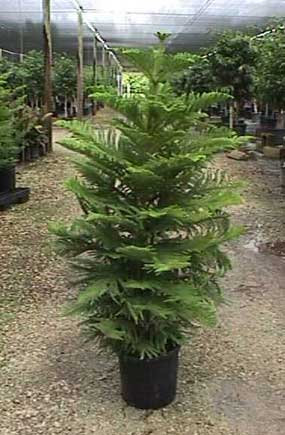
Norfolk Island Pine
Let’s look at seasonal indoor plant. If you guessed the poinsettia you guessed wrong. It’s the Araucaria, also known as the Norfolk Island pine. But the Araucaria is not a pine at all, but a member of a small family called Araucariaceae.
Where did the common name come from? Well it’s native to Norfolk Island in the Pacific. There are about 15 species, but only Araucaria heterophylla is grown for indoor use. It’s one of the few conifers that will tolerate lower light conditions. When plants are grown under low light they have a tendency to droop.
Most of the plants grown today range in container size from 4 to 10 inches with a small amount of larger sizes produced. They are generally planted as multiples of 3 plants per pot which makes for a fuller and wider plant, but a single straight plant is very attractive.
So why talk about this seasonal indoor plant? Well, during the holidays is when you will find Norfolk Island pines at their best. They make for a very attractive small potted Christmas tree. Many growers have done all the work for you by decorating the plants with red ribbons, foil and even ornaments.
Araucaria can be grown from cuttings. I remember about 30 years ago a nursery in Hawaii where you could order a large 6-8 foot rooted plant and have it shipped directly to you. But today most of the plants are grown from seed.
Most of the Norfolks grown for indoor use are grown out in full sun. This produces a compact plant but has a tendency to be a little pale in color. Once plants reach their desired height they are moved into more shade to color up.
A real upside to the Norfolk is that it does not have any real pest problems. But the downside is… they have a weak root system. Many foliage plants have an abundance of roots with no main tap root. The Norfolk has a main tap root and just does not develop a wide and extensive root system.
For this reason it is important to keep the plant stable and prevent any extra “wobble”. After going through sometimes stressful shipping, plants may need to be staked or even restaked. This will help keep them upright and also stabilize any movement which could injure the root system.
Many foliage plants also drop leaves when they are experiencing stress. However, the Norfolk generally does not drop leaves when under stress.
It’s best to keep the soil on the dry side, but when you water… water thoroughly draining off any excess water. Do not let the plant sit in water. Overwatering can cause root rot and everything is downhill from there on.
I would also recommend staying away from repotting the Norfolk. The root system can be damaged in the repotting process, extra moisture will be held in the soil, and the plant may be planted too deep. This all leads to root problems.
I cannot stress the importance of caring for the root system on the Norfolk to be successful… but itís not difficult.
- Do not repot
- Do not fertilize
- Stake the plant
- Keep the soil on the dry side
- Give the plant as much light as possible
Related Articles
- Plant Roots - Basics For Houseplants, Landscape or Lawns - Plant Roots - I’m going to beat on that drum again! The roots of plants - unfortunately - are many times the most neglected and least maintained part of the plant. Yet they are probably the most vital. Instead of considering a root is a root, let’s look a little farther. I know we in general
- Dracaena - One year to write this plant tip #2 - I told you about the Plant Tip that took a whole year to write. In case you missed our Dracaena fragrans "experiment" it you’ll find it here I promised we would take a closer look at "What has or has not happened to the plant over the last year" in greater detail. So let’s dig


[...] Norfolk Island Pine [...]