

Trees can be broken down into three main parts: the roots, the leaves and the woody structure between them. The roots’ function is to bring raw materials-water and mineral salt dissolved in water-to the tree. The leaves absorb carbon dioxide from the air and use the sun’s light energy to combine this gas with the moisture from the roots, thus making the simple sugars which are the basic nutrients of the tree.
The trunk, limbs, branches and twigs hold the leaves in position to receive the life-giving sunlight and air; they also act as transportation, carrying raw materials between roots and leaves. The materials absorbed by the roots are pulled up by capillary attraction and the osmotic action induced by evaporation of water from the leaves. Loss of water through the leaves is called transpiration. On a summer day, a single birch tree may transpire 700 to 900 gallons of water. It is this enormous flow of water that causes a continuous flow of sap from the roots to the topmost twigs.
In planting or transplanting a tree, and in building on a lot where you wish to preserve the trees, the gardener’s chief consideration must be to protect the root structure of the tree. The big roots near the stem anchor the tree to the ground, while the fine root hairs at the ends of the rootlets absorb the water from the soil.
The stem or trunk of a tree has three parts: the bark, the wood and the pith. The pith is the central part and around it is the wood. Between wood and bark is the cambium, a thin layer that produces new wood and bark. When the cambium ring is severed, as by a wire cable, the tree is killed, and since the cambium protects against insects and disease, anything driven into it can wound the tree severely.
Outside of man himself, trees have countless enemies. There are 200,000 known kinds of insects that attack trees, in addition to diseases such as blight, rust and rot, storms and droughts. Luckily, birds help to keep caterpillars, borers, beetles and other insects in check.
Here is a quick reference guide to the best trees for shade and background:
| Type | Description |
| American Beech | Beautiful tree with edible nut. Long-lived and relatively free from insect and fungal diseases. For accent planting. May be clipped, as hedge, for formal settings |
| American Elm | Very tall, with attractive vase form. Early bloom. Excellent for shade but widely disappearing because of Dutch elm disease, (pulvem necrosis) |
| American Linden | Tall tree. Provides dense shade. It has fragrant yellowish flowers. Prefers a moderately moist soil. |
| Chinese Elm | Medium height. Small dense foliage. A rapid grower, excellent for screening or windbreak. A wide spreading tree with slender limbs. Makes good shade in five years. |
| Hackberry | Usually a small tree, but with a wide spread. Has cherry-like fruit lasting late in winter. Survives drought, hardy in the cities. |
| Moraine Locust |
Majestic tree. Hardy to cold. Survives drought and flooding, smoke and soot. Lawns flourish under it since it is late in leafing, has no seeds to clutter lawn. Fast growing. |
| Norway Maple | Trees of medium height. Most widely planted street and lawn tree. Dense growth. Symmetrical. Orderly habits-free of insects and disease. Leaves turn bright yellow in fall. |
| Pin Oak | Remove lower branches if used for lawn tree. Least threatened by disease of all shade trees. Not good in alkali soil. Makes good windbreak. Symmetrical and pyramidal in shape with clean, glossy leaves. Turns scarlet in fall. |
| Red Oak | Rapid-growing tree with rounded head. A large tree appropriate for large lawns. Has glossy, deep-cut green foliage, which turns deep red in fall. |
| Silver Maple | Most rapid growing of all maples. A large spreading tree. Well-cut leaf with a silvery cast and silvery bark. Good sap for sugar making. Early blooming. |
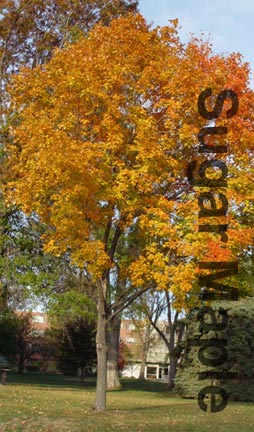
| Sugar Maple | Grows well in any soil. Ideal for street planting as it grows straight and tall and gives good shade. Turns beautiful orange and scarlet in the fall. Source of maple sugar. |
| White Clump Birch | In natural setting or as lawn specimen, this multiple-stemmed tree is effective. White bark. Upright growth with horizontal branches. |

{ 0 comments… add one now }
You must log in to post a comment.